Antarmatrika Nyasa: The Esoteric Science of Sound, Chakras, and Consciousness in Sri Vidya
A comprehensive research guide on Antarmatrika Nyasa in Sri Vidya and Tantra. Explore the placement of Sanskrit Matrika phonemes across the six chakras, the philosophical union of Shiva and Shakti, and scriptural insights on Kundalini awakening.
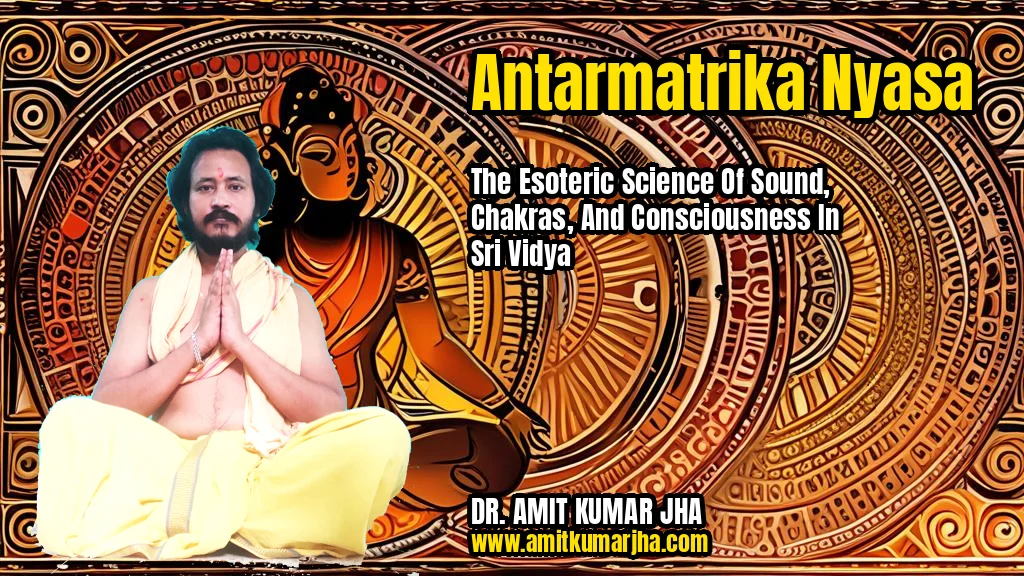

In the non-dual paradigm of Tantra and Sri Vidya Upasana, human consciousness is not separate from the cosmic fabric. Rather, the entire cosmos is understood to be a manifestation of primordial sound resonance (Nada Brahman). The Sanskrit alphabet, consisting of 50 to 51 phonemes from अ (A) to क्ष (Ksha), is not merely a vehicle for secular speech; each letter represents a subtle divine frequency, a Matrika Shakti (maternal creative force).
Among the core practices of Sri Vidya, Antarmatrika Nyasa (Internal Phonetic Placement) serves as the definitive spiritual methodology for sacralizing the physical body. By consciously projecting each Matrika letter into the lotus petals of the six subtle energy centers (Shat Chakras), the practitioner purifies speech, stabilizes vital breath (Prana), and transforms the physical vessel into a living temple of Goddess Lalita Tripura Sundari. To explore the broader framework of divine energy placements in Hindu tradition, see Nyasa Rituals on Wikipedia.
1. The Microcosmic Matrix: Mapping Matrika Varnas to the Shat Chakras
During Antarmatrika Nyasa, the practitioner systematically places specific sound syllables onto the designated petals of the internal chakras. This process purifies the subtle channels (Nadis) and activates the latent spiritual power housed at each center:
| Chakra Name | Anatomical / Subtle Location | Petals (Dalas) | Assigned Matrika Varnas (Phonemes) | |
|---|---|---|---|---|
| Vishuddhi Chakra | Throat Center (Kantha) | 16 Petals | अं, आं, इं, ईं, उं, ऊं, ऋं, ॠं, लृं, लॄं, एं, ऐं, ओं, औं, अं, अः (16 Vowels / Svaras) | Center of speech, communication, and acoustic resonance. Vowels represent the pure light of illumination (Prakash Shakti of Shiva). |
| Anahata Chakra | Heart Center (Hridaya) | 12 Petals | कं, खं, गं, घं, ङं, चं, छं, जं, झं, ञं, टं, ठं | Center of emotional synthesis and unstruck sound (Anahata Nada). Represents the expanding manifestation of power (Vimarsha Shakti). |
| Manipura Chakra | Navel Center (Nabhi) | 10 Petals | डं, ढं, णं, तं, थं, दं, धं, नं, पं, फं | Governs the fire element (Agni), Pranic dynamism, willpower, and the transformation of gross sensory experience into spiritual wisdom. |
| Swadhisthana Chakra | Genital / Pelvic Base (Lingamula) | 6 Petals | बं, भं, मं, यं, रं, लं | Governs the water element (Jala), creative fluidity, emotion, and aesthetic expression (Rasatva). |
| Muladhara Chakra | Perineum / Base of Spine | 4 Petals | वं, शं, षं, सं (Sibilants) | Governs the earth element (Prithvi), physical stability, and the abode of dormant Kundalini Shakti. |
| Ajna Chakra | Eyebrow Center (Bhrumadhya) | 2 Petals | हं, क्षं | हं signifies Shiva (pure consciousness); क्षं represents the synthesis of all creation from Ka to Ksha. Center of intuition, divine command, and non-dual insight. |
| Sahasrara Padma | Crown Center (Muradha) | 1000 Petals | All 50–51 Matrika Varnas united in non-duality | The final destination of Kundalini, where individual energy (Shakti) dissolves into absolute transcendent consciousness (Shiva). |
2. Deep Philosophical Foundations in Sri Vidya
Prakash and Vimarsha: The Union of Shiva and Shakti
In Kashmir Shaivism and Sri Vidya theology, supreme reality consists of two inseparable aspects: Prakash (the self-luminous, unchangeable light of Shiva) and Vimarsha (the dynamic self-awareness and expressive power of Shakti).
Within Antarmatrika Nyasa, the 16 vowels situated at the Vishuddhi Chakra correspond to Prakash. Vowels are independent sounds; without them, no consonant can be voiced. The consonants (Kadi to Kshadi) placed across the lower chakras represent Vimarsha—the structural expansion of divine power through the material universe. Just as consonants cannot exist without vowels, creation cannot manifest without the interplay of Shiva and Shakti.
The Vagdevatas and the Subtlest Form of Lalita Tripura Sundari
In the scriptural tradition of the Lalita Sahasranama and Khadgamala Stotram, the 51 Matrika letters are overseen by eight divine goddesses of speech known as the Vagdevatas (Vashini, Kameshwari, Modini, Vimala, Aruna, Jayini, Sarveshwari, and Kaulini). Performing Antarmatrika Nyasa aligns these subtle acoustic guardians within the practitioner's subtle anatomy. Consequently, the practitioner recognizes that their physical form is not merely composed of muscle and bone, but is a living embodiment of Goddess Lalita's mantra body (Vangmaya Sharira).
3. Classical Scriptural Reference: Yogini Hridaya
The Yogini Hridaya (a core authority within the Nitya Shodashikarnava system of Sri Vidya) outlines the necessity of Matrika Nyasa for spiritual transformation:
अक्षरात्मकमयं सर्वं वर्णरूपं जगन्मयम् ।
शरीरं भावयेद्देवि मातृकासम्पुटं तथा ॥
न्यासेन लभते सिद्धिं देही देवमयो भवेत् ।
English Transliteration:
Akṣarātmakamayaṁ sarvaṁ varṇarūpaṁ jaganmayam |
Śarīraṁ bhāvayeddevi mātṛkāsampuṭaṁ tathā ||
Nyāsena labhate siddhiṁ dehī devamayo bhavet |
Detailed Meaning:
"This entire cosmos is fundamentally composed of sound frequencies and immortal phoneme forms (Akshara). Oh Goddess, the practitioner must visualize their body as an enclosed casket containing these sacred Matrika powers. Through the systematic discipline of Nyasa, the practitioner achieves ultimate realization, transmuting the mortal vessel into a divine embodiment of supreme consciousness."
4. The Practical Stages of Acoustic Sublimation
Antarmatrika Nyasa guides internal awareness through four progressive stages of sound (Chatvari Vak):
- Vaikhari (Gross Audible Speech): The externalized, physical pronunciation of words using the tongue and lips.
- Madhyama (Mental / Intermediate Resonance): The silent, internal repetition of sounds within the mind and throat center.
- Pashyanti (Illuminated Intuitive Vibration): The visualization of sound as pure color, light, and subtle energy at the heart center (Anahata).
- Para (Transcendent Silent Consciousness): The dissolution of all sound into absolute, unmanifest awareness at the Sahasrara.
Conclusion
Antarmatrika Nyasa is far more than a ritualistic exercise; it is an esoteric discipline that bridges physical speech, internal breath, and non-dual awareness. As emphasized in the teachings of Sri Vidya masters, such as Sri Maheshwaraswarup Brahmachari Ji (Shree Manas Vidhya), "Sri Vidya deeply cherishes Nyasa" (Nyasapriya tu Srividya). By systematically placing the sacred phonemes onto the internal chakras, the practitioner transcends surface mental chatter, aligns with inner cosmic resonance, and awakens to the ultimate truth of self-realization.