Shri Yantra Navavarana: The Sacred Journey of Consciousness through 24 Tattvas and 9 Enclosures
Explore the deep spiritual journey of Shri Yantra Navavarana Sadhana, the 24 Tattvas of Samkhya philosophy, 5 Tanmatras, and sacred geometry for consciousness expansion.
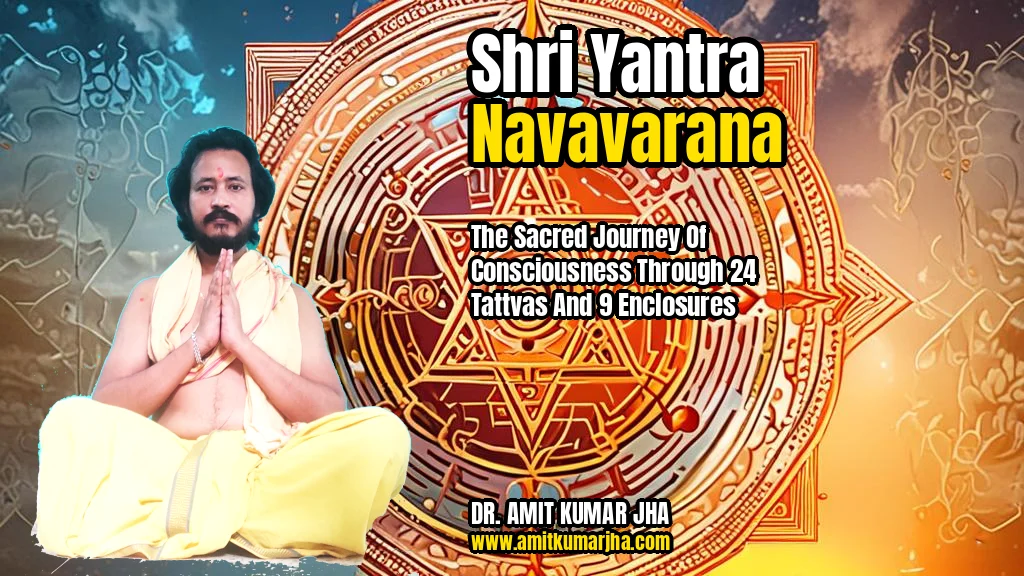

The Shri Yantra (also known as Sri Chakra) is widely recognized in Tantric and Vedic traditions not merely as a geometric pattern, but as a complete energetic blueprint of the cosmos and the human body. Rooted in Sri Vidya philosophy, the sacred geometry represents the movement of consciousness from the outer physical realm of sensory perception to the innermost realm of pure awareness—the Bindu. Under the guidance of traditional lineages like Shri Manas Vidya (Boodha Mahadev Shivalaya) led by Shri Maheshwaraswaroop Brahmachari Ji, this inward pilgrimage is recognized as a practical discipline for living a balanced, enlightened life in the everyday world.
To understand the profound depth of Sri Yantra worship, one must explore its philosophical foundation in the 24 Tattvas of Samkhya philosophy, the 5 Tanmatras (subtle sensory potentials), and the 9 Navavaranas (circuits or enclosures) that bridge the individual seeker (Jiva) with the Cosmic Consciousness (Shiva-Shakthi). For further background on sacred geometry in Tantric lore, read Sri Yantra on Wikipedia.
The 24 Tattvas of Samkhya and the 25th Tattva (Purusha)
Samkhya philosophy, one of the six classical systems of Indian thought, explains the structure of the manifest universe through 24 evolutes of Prakriti (primordial nature). Beyond these physical and subtle layers stands the 25th Tattva—Purusha—the unattached, eternal witness consciousness.
| Category | Tattvas Included | |
|---|---|---|
| Primal Cause | Prakriti (1) | The unmanifest root of all material existence. |
| Internal Organs (Antahkarana) | Mahat/Buddhi (2), Ahamkara (3), Manas (4) | Intellect/Discernment, Ego/I-ness, and Mind/Sensory Processing. |
| Sensory Organs (Gyanendriyas) | Ear, Skin, Eye, Tongue, Nose (5–9) | Instruments for receiving external sensory input. |
| Action Organs (Karmendriyas) | Speech, Hands, Feet, Excretory, Reproductive (10–14) | Instruments for expressing physical action in the world. |
| Subtle Elements (Tanmatras) | Sound, Touch, Sight, Taste, Smell (15–19) | The subtle potential energies behind gross matter. |
| Gross Elements (Mahabhutas) | Space, Air, Fire, Water, Earth (20–24) | The physical building blocks of the material cosmos. |
| Supreme Witness (25th Tattva) | Purusha (25) | The eternal, changeless consciousness observing all phenomenon. |
The 5 Tanmatras: The Microscopic Seeds of Perception
In Indian metaphysics, sensory experiences do not originate at the physical level; they emanate from subtle energetic potentials called Tanmatras. Each gross element (Mahabhuta) manifests from its corresponding Tanmatra, connecting sensory organs directly with cosmic structures:
- Shabda (Sound) Tanmatra: Originates in Akash (Space/Ether); perceived through the ears (Shrotra).
- Sparsha (Touch) Tanmatra: Originates in Vayu (Air); perceived through the skin (Tvach).
- Rupa (Sight/Form) Tanmatra: Originates in Agni/Tejas (Fire); perceived through the eyes (Chakshu).
- Rasa (Taste) Tanmatra: Originates in Jala/Aap (Water); perceived through the tongue (Rasana).
- Gandha (Smell) Tanmatra: Originates in Prithvi (Earth); perceived through the nose (Ghrana).
The 9 Navavaranas: The Inward Journey of the Spiritual Seeker
The Shri Yantra consists of nine distinct circuit layers or Navavaranas. During spiritual contemplation (Sadhana), the practitioner moves mentally or ritualistically from the outermost square enclosure toward the central point (Bindu), transcending layers of conditioning at each step.
1. Trilokyamohana Chakra (Outermost Square Enclosure)
Represents the outer physical world, sensory attractions, and initial worldly desires. The seeker acknowledges sensory inputs without becoming trapped by attachment.
2. Sarvashaparipuraka Chakra (16-Petaled Lotus)
The realm where desires and aspirations are fulfilled and refined. The seeker shifts focus from selfish cravings toward elevated spiritual goals.
3. Sarvasankshobhana Chakra (8-Petaled Lotus)
Focuses on inner churnings, emotional turbulence, and the resolution of deeply ingrained mental impressions (Samskaras).
4. Sarvasaubhagyadayaka Chakra (14-Triangled Circuit)
Establishes inner balance, auspiciousness, emotional harmony, and a positive outlook on life's duties.
5. Sarvarthasadhaka Chakra (Outer 10-Triangled Circuit)
Transitions the practitioner from mere desire to clear purpose, aligning daily work with spiritual discipline.
6. Sarvarakshakara Chakra (Inner 10-Triangled Circuit)
Provides deep emotional stability, spiritual protection, and resilience against negative internal states.
7. Sarvarogahara Chakra (8-Triangled Circuit)
The zone of total healing where ignorance, attachment, and psychological afflictions (Roga) are recognized and eliminated.
8. Sarvasiddhiprada Chakra (Inverted Central Triangle)
Represents the culmination of Sadhana, awakening subtle inner capacities (Siddhis) and high spiritual maturity.
9. Sarvanandamaya Chakra (The Central Point / Bindu)
The ultimate center of supreme bliss (Ananda) and unity. Here, the distinction between the observer, the observed, and the process of observation dissolves into non-dual awareness (Advaita).
Scriptural Foundations in Classical Tantric Literature
The profound union of Shiva and Shakti at the central Bindu of Shri Yantra is vividly described in the opening verse of Adi Shankaracharya’s famous hymn, Saundarya Lahari.
1. Verse 1 from Saundarya Lahari
Original Sanskrit Shloka:
शिवः शक्त्या युक्तो यदि भवति शक्तः प्रभवितुं
न चेदेवं देवो न खलु कुशलः स्पन्दितुमपि ।
अतस्त्वामाराध्यां हरिहरविरिञ्चादिभिरपि
प्रणन्तुं स्तोतुं वा कथमकृतपुण्यः प्रभवति ॥
English Transliteration:
Śivaḥ śaktyā yukto yadi bhavati śaktaḥ prabhavituṁ
Na chedevam devo na khalu kuśalaḥ spanditumapi |
Atastvāmārādhyāṁ hariharaviriñchādibhirapi
Praṇantuṁ stotuṁ vā kathamakṛtapuṇyaḥ prabhavati ||
Meaning and Interpretation:
"Only when Shiva is united with Shakti does He acquire the power to create the universe. Without Her, the Divine is unable even to stir. How then can one who has not performed merit in past lives bow to or praise You, who are worshiped even by Brahma, Vishnu, and Shiva?"
Integrating Spiritual Realization into Daily Life
Reaching the central Bindu is not the final step of true Sadhana; the ultimate goal is carrying that realized consciousness back into daily activity. True spiritual practice manifests through clear thinking, emotional composure, compassionate relationships, and selfless service to society. The journey inward serves to purify the individual so they can act in the world with wisdom and grace.
Global Parallels: Sacred Geometry, Western Esotericism, and Transpersonal Psychology
The symbolic journey depicted in the Shri Yantra finds remarkable resonances across Western spiritual systems, philosophy, and modern psychology.
In classical Western esotericism and Hermetic traditions, sacred diagrams like the Tree of Life (Kabbalah) depict the cosmos and human consciousness through ten interrelated spheres (Sephirot). Similar to the Navavaranas of Shri Yantra, movement through the Kabbalistic Tree represents a progressive journey from the physical world (Malkuth) upward toward the unmanifest divine source (Kether). Learn more about The Tree of Life on Wikipedia.
Furthermore, Swiss psychologist Carl Gustav Jung extensively studied sacred geometric diagrams across cultures, coining the psychological framework of the Mandala. Jung observed that when individuals engage with centered concentric structures, it facilitates the process of individuation—integrating the conscious ego with the deeper, universal Self. Modern transpersonal psychology continues to validate this principle, demonstrating that visual meditation on structured geometric forms calms the nervous system, enhances spatial cognition, and fosters holistic psychological integration.
Conclusion: The Eternal Relevance of Sri Vidya
The Sri Yantra is far more than an ancient motif; it is a timeless map of human evolution. By recognizing the 24 Tattvas, mastering sensory inputs through the 5 Tanmatras, and traversing the 9 Navavaranas with devotion, a seeker discovers that the ultimate sacred temple resides within their own awareness.