Goddess Sharada: Unveiling the Green-Hued Fourth Face of Shadvaktra Kamarupa Devi
An in-depth research analysis of Goddess Sharada, the emerald-hued fourth face of Shadvaktra Kamarupa Devi from Chapter 64 of the Kalika Purana. Includes Sanskrit Shlokas, English meanings, scriptural references, and Tantric symbolism.
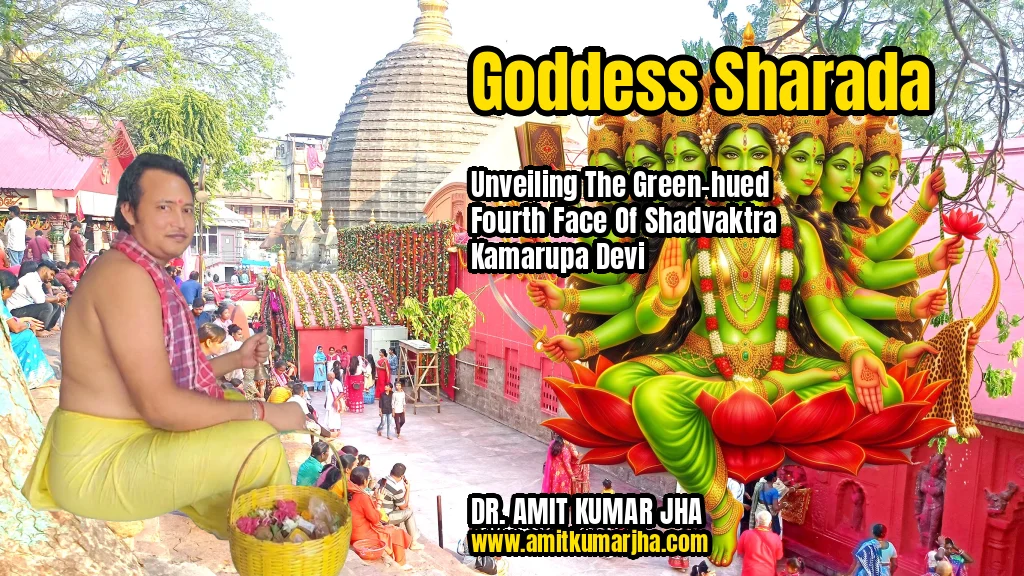

In the vast ocean of Shakta literature, the Kalika Purana holds an indispensable position. It acts as an authoritative ritualistic and philosophical manual dedicated to the worship of the Supreme Cosmic Mother in her various transformative forms. Central to this tradition is the ancient region of Kamarupa (modern-day Assam, India), home to the famous Shakti Peeth of Kamakhya. Within this esoteric tradition, the Mother Supreme manifests as Shadvaktra Kamarupa Devi—a majestic deity possessing six distinct faces, eighteen divine eyes, and twelve powerful arms.
Chapter 64 of the Kalika Purana provides a detailed breakdown of this composite manifestation. Each of her six faces represents a unique cosmic attribute, color, direction, and energy state. Among these six radiant countenances, the fourth face is named Sharada, defined specifically by her mesmerizing emerald-green complexion (Haritavarna). While popular culture often associates Goddess Sharada exclusively with the white-clad deity of learning, the ancient esoteric tradition reveals her as a dynamic, green-hued aspect of the Supreme Shakti who blends intellectual illumination, nature's vital energy, and formidable protective force.
This comprehensive blog explores the iconography, scriptural references, weapons, visual meditation techniques, and the complete Sharada Ashtakam with original Sanskrit Shlokas and line-by-line English translations.
1. The Cosmic Ordering of the Six Faces in Kalika Purana
The Kalika Purana explains that the universe operates through various colors and vibrations of divine energy. When the Supreme Mother assumes her Shadvaktra (six-faced) form in the sacred land of Kamarupa, her countenances exhibit distinct hues that correspond to different phases of creation, preservation, and dissolution. Chapter 64 explicitly lays down the sequence and color assigned to each of these six divine faces.
The scriptural order of the six faces of Shadvaktra Kamarupa Devi is described as follows:
- Maheshwari (First Face): Displays a pristine white color (Shweta), symbolizing absolute purity, transcendent stillness, unblemished consciousness, and the foundational principle of Lord Shiva.
- Kamakhya (Second Face): Exhibits a vibrant crimson red color (Rakta), representing intense creative desire, life force, passion, and the primal impulse of cosmic origination.
- Tripura (Third Face): Shows a brilliant golden-yellow color (Peeta), embodying divine wisdom, illumination, intellectual clarity, and spiritual prosperity.
- Sharada (Fourth Face): Characterized by a soothing green color (Harita), symbolizing fresh nature, vitality, rejuvenation, cognitive growth, and endless life-nourishing energy.
- Kameshwari (Fifth Face): Possesses a deep, mysterious black color (Krishna), signifying the unmanifest void, supreme potential, absorption, and cosmic dissolution.
- Chanda (Sixth Face): Displays a multi-colored or variegated pattern (Chitravarna), representing the immense diversity, complexity, and multiplicity of the physical universe.
This color arrangement is far from arbitrary. In Vedic and Tantric traditions, color serves as a physical representation of subtle energy frequencies. The green hue of Sharada sits right between the yellow light of Tripura (wisdom) and the dark absorption of Kameshwari (transcendence), making her the essential bridge that turns wisdom into living, breathing action.
2. The Symbolism of the Green Complexion (Haritavarna)
The defining feature of the fourth face, Goddess Sharada, is her emerald-green skin (Haritavarna). In classical Sanskrit literature, the word Harita refers to green foliage, new shoots, tender sprouts, and the lush radiance of nature after rain. This green hue evokes the feeling of vitality, organic growth, freshness, and the unending restorative energy of the Mother Earth.
The visual composition of Sharada’s green face is breathtaking. Her emerald skin glows with a subtle golden undertone, creating an aura of radiant divine light. Her face is surrounded by a soft green halo (Prabhamandala), adorned with lustrous gold ornaments, rubies, and pearls. This unique combination makes her look remarkably different from the golden-yellow Tripura and the pitch-black Kameshwari.
Scripturally, green is deeply connected to the element of earth and the principle of renewal. As the Vedic Rigveda declares in the Devi Suktam (Rigveda 10.125), the Mother Supreme is the ultimate support of the physical world, sustaining all life forms through her organic power:
"अहं राष्ट्री संगमनी वसूनां चिकितुषी प्रथमा यज्ञियानाम्।
तां मा देवा व्यदधुः पुरुत्रा भूरिस्थात्रां भूर्यवेशयन्तीम्॥"
Transliteration: Ahaṁ rāṣṭrī saṁgamanī vasūnāṁ cikituṣī prathamā yajñiyānām | Tāṁ mā devā vyadadhuḥ purutrā bhūristhātrāṁ bhūryāveśayantīm ||
Meaning: "I am the Sovereign Queen of the cosmos, the gatherer of all treasures, the knower of Truth, and the first among those worthy of worship. The divine forces have established me in many places, abiding in countless forms and entering into all created beings."
The green hue of Sharada is the physical manifestation of this Vedic truth. It represents the nourishing aspect of the Goddess, ensuring that spiritual wisdom does not remain a dry, abstract concept, but blooms into a vibrant, creative life.
3. The Comprehensive Form of Shadvaktra Kamarupa Devi
To truly understand the fourth face, one must visualize her within the entire form of Shadvaktra Kamarupa Devi. The scriptures describe this deity as a unified, majestic figure whose six faces look out across the six directions of space (East, West, North, South, Above, and Below).
The complete iconography of the Goddess includes the following details:
- Six Faces (Shad Vaktra): Each face represents a distinct color and divine attribute, with Sharada glowing brightly on the fourth side.
- Eighteen Eyes (Ashtadasha Akshi): Each face features three glowing eyes (the two physical eyes plus the spiritual third eye of wisdom), giving her complete vision over the past, present, and future.
- Twelve Arms (Dwadasha Bhuja): Her twelve arms stretch out to protect her devotees, holding a balanced mix of spiritual instruments, defensive shields, and offensive weapons.
- Crescent Moons (Ardhachandra): Every face is crowned with a gleaming crescent moon resting upon her forehead, symbolizing her mastery over time, mind, and spiritual illumination.
- Adornments and Attire: Her head is crowned with gem-encrusted tiaras, and her dark blue, silky hair flows around her shoulders. She wears necklaces crafted from pearls, rubies, and emeralds, reflecting her divine beauty.
4. The Twelve Divine Arms: Weapons and Symbols
The twelve arms of Shadvaktra Kamarupa Devi hold weapons and spiritual instruments that balance knowledge, spiritual practice, protection, and destructive energy. These implements demonstrate that the Goddess nurtures her devotees with wisdom while defending them against negative forces.
The Six Right Hands (Dakshina Bhuja)
- 1. Pustaka (Sacred Book): Symbolizes infinite scriptural wisdom, divine knowledge, self-realization, and the preservation of truth.
- 2. Siddhasutra (Sacred Thread/Thread of Attainment): Represents ritual purity, spiritual discipline, and the unbreakable connection between the individual soul and the Divine.
- 3. Panchabana (Five Arrows): Represents control over the five senses (sight, sound, taste, touch, smell) and the five subtle elements (earth, water, fire, air, space).
- 4. Khadga (Sword): Symbolizes the sharp blade of wisdom that cuts through spiritual ignorance, delusion, and ego.
- 5. Shakti (Spear/Lance): Represents focused willpower, spiritual momentum, and irresistible energy.
- 6. Shula (Trident): Represents mastery over the three worlds (physical, subtle, causal) and the removal of physical, mental, and spiritual suffering.
The Six Left Hands (Vama Bhuja)
- 1. Akshamala (Japa Rosary): Symbolizes steady meditation, mantra repetition, and the unbroken cycle of cosmic time.
- 2. Mahapadma (Great Lotus): Represents spiritual purity, the awakening of inner chakras, and rising above worldly impurities.
- 3. Kodanda (Bow): Represents focused mental concentration and target-oriented spiritual endeavor.
- 4. Abhaya Mudra (Gesture of Fearlessness): A divine hand position granting immediate protection, comfort, and freedom from all fears.
- 5. Charma (Shield): Symbolizes defense against external attacks, negative planetary influences, and evil energies.
- 6. Pinaka (Divine Bow of Shiva): Represents cosmic order, spiritual defense, and unyielding justice.
This balance of weapons and peaceful symbols highlights the dual nature of Shakti. In the Markandeya Purana (Durga Saptashati, Chapter 4, Sloka 17), the gods praise the Mother Supreme for this exact balance:
"सौम्या सौम्यतराशेषसौम्येभ्यस्त्वतिसुन्दरी।
परापराणां परमा त्वमेव परमेश्वरी॥"
Transliteration: Saumyā saumyatarāśeṣasaumyebhyastvatisundarī | Parāparāṇāṁ paramā tvameva parameśvarī ||
Meaning: "You are supremely gentle, more charming than all gentle things, and infinitely beautiful. You are the transcendent Supreme Ruler, beyond both the manifest and unmanifest worlds."
5. Visual Meditation on Goddess Sharada
In traditional Tantric practices, visual meditation (Dhyana) is used to steady the mind and connect with the deity's inner energy. Practitioners meditating on the fourth face of Shadvaktra Devi focus on a specific mental image of Goddess Sharada.
Imagine the six-faced Goddess seated upon a golden lotus in the heart of Kamarupa. Direct your attention to her fourth face, which shines with a brilliant emerald-green radiance. A soft golden light glows beneath her skin, giving her countenance an otherworldly warmth. On her forehead sits a gleaming crescent moon, casting a cool white light across her emerald features.
Her three eyes shine with deep intelligence and maternal compassion. Her dark, glossy hair flows around a gem-encrusted crown, while golden earrings brush against her green cheeks. Surrounding her face is a halo of green light that looks like a field of fresh spring leaves. Viewing this form fills the practitioner's mind with deep peace, mental clarity, and fresh vital energy.
6. The Tantric Significance of Kamarupa Mahapeeth
The manifestation of Shadvaktra Devi is tied directly to the Kamarupa Mahapeeth in Assam. According to Puranic tradition, when the body of Goddess Sati was severed by Lord Vishnu's Sudarshana Chakra, her Yoni Peeth (the sacred center of creation) fell at Kamagiri in Kamarupa.
Because this site represents the creative womb of the universe, the spiritual energy here is uniquely dynamic. Worshipping the Goddess as Shadvaktra in Kamarupa allows practitioners to connect with all six aspects of creation simultaneously. In this setup, Sharada represents the vital life force that turns spiritual ideas into reality. She ensures that the seeker's spiritual growth remains grounded, balanced, and productive.
7. The Complete Sharada Ashtakam: Text, Transliteration, and Meanings
The Sharada Ashtakam is a dedicated eight-verse prayer celebrating the emerald-hued fourth face of Shadvaktra Devi. Reciting this hymn daily is believed to bring mental clarity, spiritual wisdom, protection, and physical vitality.
Verse 1
हरिताभां महादेवीं, षड्वक्त्रां शक्तिरूपिणीम्।
अर्धचन्द्रकिरीटाढ्यां, शारदां प्रणमाम्यहम्॥ १ ॥
Transliteration: Haritābhāṁ mahādevīṁ, ṣaḍvaktrāṁ śaktirūpiṇīm | Ardhacandrakirīṭāḍhyāṁ, śāradāṁ praṇamāmyaham || 1 ||
Meaning: I bow down reverently to Goddess Sharada, who radiates a brilliant green hue. She is the Great Goddess, the embodiment of divine power residing within the six-faced form, adorned with a shining crescent moon upon her crown.
Verse 2
अष्टादशाक्षिदीप्तां तां, द्वादशभुजशोभिताम्।
रत्नालंकारभूषाढ्यां, वन्दे देवीं सनातनीम्॥ २ ॥
Transliteration: Aṣṭādaśākṣidīptāṁ tāṁ, dvādaśabhujaśobhitām | Ratnālaṁkārabhūṣāḍhyāṁ, vande devīṁ sanātanīm || 2 ||
Meaning: I offer my salutations to the eternal Goddess, whose presence is illuminated by eighteen glowing eyes and beautified by twelve powerful arms. She is gorgeously decorated with precious gem-studded ornaments.
Verse 3
पुस्तकं सिद्धसूत्रं च, पंचबाणं च धारिणीम्।
खड्गशक्तिशूलहस्तां, नमामि शक्तिरूपिणीम्॥ ३ ॥
Transliteration: Pustakaṁ siddhasūtraṁ ca, paṁcabāṇaṁ ca dhāriṇīm | Khaḍgaśaktiśūlahastāṁ, namāmi śaktirūpiṇīm || 3 ||
Meaning: I bow to her who is the true form of Shakti. In her right hands, she holds the sacred book of wisdom, the sacred thread of spiritual attainment, the five subtle arrows, the sword of knowledge, the spear of power, and the trident of destruction.
Verse 4
अक्षमालां महापद्मं, कोदण्डं च पिनाककम्।
अभयां चर्मसंयुक्तां, ध्यायामि शारदाम्बिकाम्॥ ४ ॥
Transliteration: Akṣamālāṁ mahāpadmaṁ, kodaṇḍaṁ ca pinākakam | Abhayāṁ carmasaṁyuktāṁ, dhyāyāmi śāradāmbikām || 4 ||
Meaning: I meditate upon Mother Sharada, who holds in her left hands the rosary of meditation, the great lotus, the Kodanda bow, the Pinaka bow, the protective shield, and the fear-dispelling Abhaya gesture.
Verse 5
हरितप्रभासमायुक्तां, मंगलां ज्ञानदायिनीम्।
भक्तानां हितकर्त्रीं तां, प्रणमामि जगन्मयीम्॥ ५ ॥
Transliteration: Haritaprabhāsamāyuktāṁ, maṁgalāṁ jñānadāyinīm | Bhaktānāṁ hitakartrīṁ tāṁ, praṇamāmi jaganmayīm || 5 ||
Meaning: I bow to the universal Mother, who is filled with a green radiance. She is all-auspicious, the bestower of true spiritual wisdom, and the constant well-wisher who works for the highest good of her devoted seekers.
Verse 6
कामरूपमहापीठे, शक्तिरूपेण संस्थिताम्।
भक्तानां भयहारिण्यै, नमो देवी शारदे॥ ६ ॥
Transliteration: Kāmarūpamahāpīṭhe, śaktirūpeṇa saṁsthitām | Bhaktānāṁ bhayahāriṇyai, namo devī śārade || 6 ||
Meaning: Salutations to Goddess Sharada, who is firmly established as the supreme power at the sacred Kamarupa Mahapeeth. She removes all fear and anxiety from the hearts of her devotees.
Verse 7
ज्ञानदीपप्रदां देवीं, चेतनाज्योतिरूपिणीम्।
सर्वमंगलदां नित्यं, भजे शारदामम्बिकाम्॥ ७ ॥
Transliteration: Jñānadīpapradāṁ devīṁ, cetanājyotirūpiṇīm | Sarvamaṁgaladāṁ nityaṁ, bhaje śāradāmambikām || 7 ||
Meaning: I daily worship Mother Sharada, who lights the lamp of divine wisdom within us. She is the living flame of pure consciousness and the eternal bestower of all prosperity and auspiciousness.
Verse 8
जय शारदे महाशक्ते, जय हरितरूपिणि।
कृपां कुरु जगन्माते,नमस्ते परमेश्वरि॥ ८ ॥
Transliteration: Jaya śārade mahāśakte, jaya haritarūpiṇi | Kṛpāṁ kuru jaganmāte, namaste parameśvari || 8 ||
Meaning: Victory to Goddess Sharada, the supreme power! Victory to her whose form shines with a divine green hue! O Mother of the Universe, shower your grace upon us. I bow down to you, Supreme Ruler of the cosmos!
8. Summary and Final Reflections
Goddess Sharada, as the green-hued fourth face of Shadvaktra Kamarupa Devi, offers us a rich perspective on Shakti worship. Far from being a simple iconographic detail, her green color (Haritavarna) highlights the deep connection between divine wisdom, nature, and living spiritual energy.
By studying Chapter 64 of the Kalika Purana and contemplating her form—adorned with twelve weapons, crowned with the crescent moon, and residing at the sacred Kamarupa Peeth—seekers can appreciate the complete nature of the Mother Supreme. She is the sword of knowledge that cuts through illusion, the gentle shield that protects against fear, and the green life force that keeps our spiritual journey blooming with vital energy.