Yoni Tantra: Sacred Geometry, Esoteric Worship, and the Philosophy of the Cosmic Origin
Explore the deep spiritual science of Yoni Tantra in Shakta Traditions. Discover Yoni Yantra worship practices, Beej Mantras, authentic Sanskrit Shlokas, and universal parallels of the Divine Feminine.
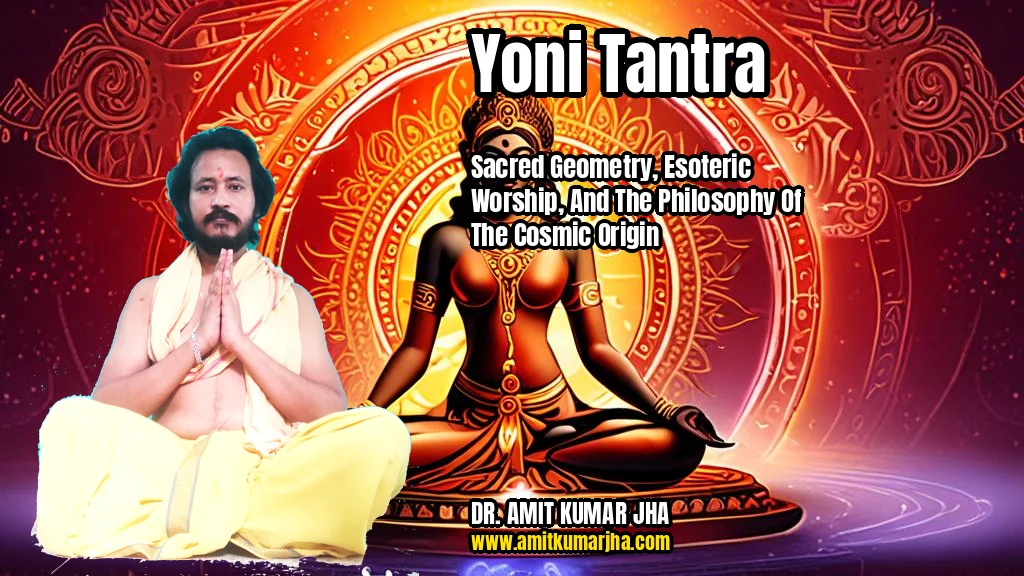

In the profound non-dual lineage of Shakta Tantra, the text known as the Yoni Tantra represents one of the most esoteric and revered manuals of Adi Shakti worship. Contrary to superficial interpretations that view bodily forms strictly through mundane physical or sensational lenses, Tantric philosophy views the physical form as a microcosm of the entire cosmos (Yatha Pinde Tatha Brahmande). In this vision, the Yoni is honored as the physical manifestation of Kamakhya, the primordial vortex of creation, preservation, and dissolution (Srishti, Sthiti, Laya).
Through systematic ritual protocols, geometric Yantra invocation, and sacred Beej Mantras, the Yoni Tantra guides the sadhaka (practitioner) away from crude attachment toward a realization of the supreme consciousness embedded within the Divine Feminine. For more background on the sacred geometry of the Divine Feminine in Tantric traditions, see Yantra on Wikipedia.
Methodology of Yoni Yantra Worship (षोडशोपचार पूजन विधि)
Similar to the sacred rites performed at the Kamakhya Shakti Peeth in Assam and the worship of the Shri Yantra, the worship of the Yoni Yantra requires rigorous physical purity, focused mental restraint (Dharana), and reverent devotion.
- Purification and Preparation (शुद्धि): The sadhaka performs ritual ablutions, puts on clean red attire, and sits on a consecrated mat (Asana) facing East or North.
- Formulation of Intent (संकल्प): Holding water and sacred rice (Akshata) in the right palm, the practitioner states the formal intent: "Mam Sarva-Siddhi Praptyartham Yoni-Yantra Poojanam Karishye."
- Yantra Consecration (यंत्र स्थापना): The Yoni Yantra—engraved on copper plate or drawn on Birch bark (Bhojpatra)—is placed upon a bed of fresh red lotus flowers. It is consecrated with holy water (Gangajal) and raw milk.
- Quad-Directional Invocation (आवरण पूजन): The sadhaka invokes the four cardinal manifestations of the Supreme Goddess at the corners of the Yantra:
- East:
- South:
- West:
- North:
- Sixteen-fold Offerings (षोडशोपचार): The Yantra is offered red sandalwood paste, fresh red hibiscus blossoms, incense, oil lamps, and pure food offerings (Naivedya).
Primary Beej Mantras of the Yoni Tantra
Mantras in Tantra are considered sonic incarnations of the deity. The core text highlights specific seed syllables (Beeja) to purify the mental landscape of the sadhaka:
| Mantra Classification | Sanskrit Transliteration | Esoteric Significance |
|---|---|---|
| Moola Beej Mantra | Om Hreem Yoni Roopinyai Namah | Invokes Bhuvaneshwari (Hreem) within the manifestation of the cosmic matrix. |
| Bhaga Beej Mantra | Om Bhagāyai Namah | Honors the supreme source of divine wealth, radiance, and generative force. |
| Navarna Mahamantra | Om Aim Hreem Kleem Chamundayai Vicche | Synthesizes Saraswati (Aim), Lakshmi (Hreem), and Kali (Kleem) for total liberation. |
| Protective Shield (Kavacha) | Yonirmām Pātu Sarvadā | Establishes a spiritual safeguard, surrendering the self to the protection of the Cosmic Mother. |
Authentic Verses from the Yoni Stotram
The Yoni Stotram, an integral hymn within the Yoni Tantra, encapsulates the theological essence of Shakti worship through precise poetic meter.
Verse 1: The Matrix of the Ten Mahavidyas
ॐ भग-रूपा जगन्माता सृष्टि-स्थिति-लयान्विता ।
दशविद्यास्वरूपात्मा योनिर्मां पातु सर्वदा ॥
English Transliteration:
Om Bhaga-rūpā Jaganmātā Sṛṣṭi-sthiti-layānvitā |
Daśavidyāsvarūpātmā Yonirmām Pātu Sarvadā ||
Meaning:
"Salutations to the Divine Mother of the Universe who manifests as the cosmic origin (Bhaga), governing creation, sustenance, and dissolution. She whose very soul embodies the Ten Great Wisdom Goddesses (Das Mahavidya)—may that sacred origin protect me eternally."
Verse 2: The Triadic Source of Transcendence
कोण-त्रय युता देवि स्तुति-निन्दा विवर्जिता ।
जगदानन्द-सम्भूता योनिर्मां पातु सर्वदा ॥
English Transliteration:
Koṇa-traya Yutā Devi Stuti-nindā Vivarjitā |
Jagadānanda-sambhūtā Yonirmām Pātu Sarvadā ||
Meaning:
"O Goddess who resides in the primary triangle (representing Iccha/Will, Jnana/Knowledge, and Kriya/Action), who stands completely beyond praise and blame, and from whom the supreme bliss of the universe springs—may that sacred origin protect me eternally."
Verse 3: The Abode of Mahakali
योनिमध्ये महाकाली छिद्ररूपा सुशोभना ।
सुखदा मदनागारा योनिर्मां पातु सर्वदा ॥
English Transliteration:
Yonimadhye Mahākālī Chidrarūpā Suśobhanā |
Sukhadā Madanāgārā Yonirmām Pātu Sarvadā ||
Meaning:
"At the center of the cosmic origin dwells Mahakali in absolute splendor—granting spiritual bliss and housing the radiant energy of divine desire. May that sacred origin protect me eternally."
Philosophical Realization: Beyond the Physical Form
The core message of the Yoni Tantra is summarized in its famous declaration: "Yonirūpā Mahāvidyā Sarvadā Mokṣadāyinī"—the realization of the cosmic origin as the embodiment of highest wisdom is the direct giver of liberation (Moksha).
Tantric treatises break down the physical architecture of the feminine form into a sacred map of the Three Great Goddesses (Tridevi):
- The Outer Petals (Bhagoshta): Associated with Mahalakshmi, symbolizing protective grace, abundance, and auspicious beauty.
- The Central Cavity (Gahvara): Associated with Mahakali, symbolizing the profound void, transformative fire, and infinite potential.
- The Inner Matrix / Root (Garbhanala): Associated with Mahasaraswati, symbolizing creative genesis, wisdom, and structural order.
Consequently, authentic Shakta Tantra establishes that true Yoni Poojan cannot exist without absolute, unwavering reverence for women in daily life. Harm, disrespect, or degradation directed toward any woman invalidates all ritual worship, as women are held to be the direct living manifestations (Swarupa) of the Divine Mother on Earth.
Global Parallels: Sacred Feminine Archetypes in World Traditions
The philosophical reverence for the generative feminine principle as the origin of existence is not unique to India; it is a universal archetype found across ancient global civilizations.
In ancient Egyptian mythology, the goddess Isis was revered as the mother of nature and the ultimate source of magic and creation, often symbolized by the sacred knot (Tyet), representing the womb of the divine. Similarly, in ancient Mesopotamian traditions, Inanna (Ishtar) represented the raw, transformative power of life, desire, and cosmic sovereignty. To read further on historical veneration of the cosmic womb across cultures, explore Goddess Archetypes on Wikipedia.
In classical Daoist philosophy, the Daodejing explicitly invokes the metaphor of the cosmic womb, referring to the Dao as "the Mysterious Female" (Valley Spirit)—the silent, receptive, and eternal gateway through which Heaven and Earth continually emerge. These global parallels demonstrate how human consciousness across continents has naturally recognized the Divine Feminine as the ultimate portal of life, wisdom, and cosmic return.
Conclusion
The Yoni Tantra elevates human perception from physical limitation to cosmic consciousness. By viewing creation through the lens of sacred geometry, devotional mantra, and deep moral reverence for women, the practitioner transcends dualistic bondage and achieves the ultimate union of Shiva and Shakti.