

Shri Rajashyamala and Uchchhishta Chandalini: Scriptural Distinctions in Iconography, Yantra Geometry, and Kaula Tantra
An authentic research analysis distinguishing Shri Rajashyamala and Uchchhishta Chandalini across Shakta and Kaula Agamas, Tantrasara, Rudrayamala, and the Atharvaveda.

Sitting at the pinnacle of the Shakta and Kaulachara traditions, the esoteric literature surrounding Goddess Matangi, Shri Rajashyamala, and Uchchhishta Chandalini represents one of the most profound and closely guarded streams of Indian spiritual philosophy. A meticulous examination of foundational texts—such as the Tantrasara, Phetkarini Tantra, Rudrayamala, Mantramahodadhi, Saubhagyalakshmi Kalpa, and the Uchchhishta Sukta of the Atharvaveda—reveals that attempting to interpret these Mahavidyas through the lens of ordinary exoteric ritualism leads to fundamental errors.
In contemporary spiritual art and popular interpretations, serious mistakes are frequently committed by conflating their iconography, Yantra geometry, and Mantra procedures. This research monograph provides an authoritative synthesis of these supreme cosmic energies across five core pillars: iconographic distinctions, Yantra architecture, Tantric fire rituals (Homa), Mantra awakening, and the ultimate non-dual Kaula realization.
1. Iconographic Ontology (Vigraha-Tattva) and Agama Exegesis
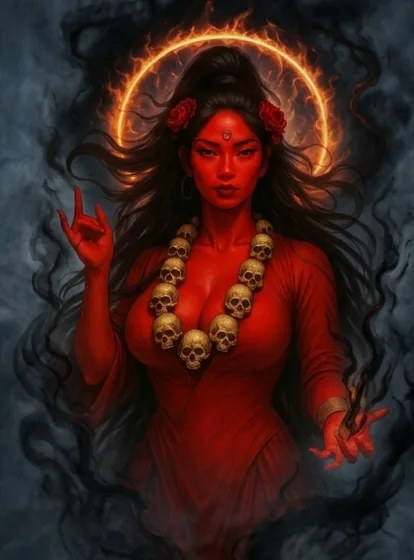
Depending on the lineage (Amnaya) and the specific mode of worship (Upasana-bheda), the Goddess manifests in three distinct iconographic frameworks. Mixing the attributes of these three forms violates scriptural integrity and creates what Tantric texts define as Pratima-Dosha (iconographic defect).
- Ugra Uchchhishta Chandalini (Sumukhi Shmashana-Matangi): This represents the fierce left-hand Kaula (Vama-Kaula) and cremation-ground sadhana aspect. Here, the Goddess is depicted as Shavasana (seated upon a corpse), clad in crimson garments, adorned with blood-red ornaments, and holding a skull-cup (Kapala) and a ritual cleaver or knife (Kartrika).
- Vashya-Matangini (Four-Armed Uchchhishta-Matangi): Detailed prominently in the Tantrasara and Phetkarini Tantra, this is the four-armed magnetic and subjugating manifestation. In this form, the Goddess wields a sword (Khadga), a shield or mace (Khetaka or Mudgara), a noose (Pasha), and an elephant goad (Ankusha).
- Rajamatangi and Rajashyamala (Mantrini Amba): This is the graceful, sovereign, and royal manifestation central to Sri Vidya and the Dakshina-Vama Kaula synthesis, where she serves as the Prime Minister (Mantrini) to Lalita Tripurasundari. Seated upon a jeweled throne (Ratnapitha) in the middle of an ocean of nectar, she listens attentively to the sweet speech of a parrot (Shuka), plays a ruby-studded lute (Manikya Veena), holds a conch vessel, and radiates divine spiritual intoxication.
Modern illustrators frequently place a skull-cup and cleaver into the hands of the Veena-playing Rajashyamala, or depict the fierce Vashya-Matangi seated serenely on a lotus. According to the Bhrigu Samhita and Agamic canons, this constitutes Bhava-Sankara Dosha (adulteration of contemplative mood), which obstructs the practitioner's attainment of Vak-Siddhi (perfection of speech). The seat of fierce Sumukhi is a corpse or Yoni-pitha, whereas the seat of Rajashyamala is an imperial jeweled throne.
In the classical Matangi Dhyana of the Tantrasara, the royal contemplative form of Rajashyamala is vividly invoked:
माणिक्यवीणामुपलालयन्तीं मदालसां मञ्जुलवाग्विलासाम्।
माहेन्द्रनीलद्युतिकोमलाङ्गीं मातङ्गकन्यां मनसा स्मरामि॥
English Transliteration:
Māṇikyavīṇāmupalālayantīṁ madālasāṁ mañjulavāgvilāsām |
Māhendranīladyutikomalāṅgīṁ mātaṅgakanyāṁ manasā smarāmi ||
Detailed Meaning:
"I meditate in my mind upon the daughter of Sage Matanga (Rajashyamala), who gently caresses a ruby-studded Veena, whose eyes are languid with divine bliss, who delights in sweet and eloquent speech, and whose delicate limbs shine with the lustrous dark-blue radiance of a sapphire."
2. Yantra Architecture, Pitha-Shaktis, and Avarana Worship
In Tantric science, a Yantra is not merely a symbolic geometric drawing; it is the direct, linear body of the deity composed of mantra vibrations. The architectural layout (Yantroddhara) of Sumukhi and Rajashyamala differs sharply in the number of triangles and lotus petals.
Geometric Distinctions in Yantroddhara
- Sumukhi (Ugra Uchchhishta Chandalini) Yantra: At its center lies the Bindu (primordial point), enclosed by a single downward-pointing triangle (Adhomukha Trikona), surrounded by an eight-petaled lotus (Ashtadala Padma), and framed by a four-gated square enclosure (Chaturdvara Bhupura).
- Rajashyamala Gitichakra: Within the Sri Vidya tradition, the Yantra of Rajashyamala is revered as the Gitichakra (Wheel of Cosmic Melody). Its intricate geometry comprises a central Bindu, an inverted triangle, a pentagon (Panchakona), an eight-petaled lotus, a sixteen-petaled lotus (Shodashadala), an outer four-petaled lotus (Chaturdala), and a triple-walled enclosure (Trimekhala Bhupura). The outer four petals specifically symbolize the four Vedas (Rig, Yajur, Sama, and Atharva).
Differences in Pitha and Avarana (Circuit) Worship
- The Cremation-Ground Avarana of Sumukhi: In fierce sadhana, worship centers on the Yoni-mandala and Matanga Bhairava. Its surrounding circuit honors sixteen fierce cremation-ground energies (Shmashana-vasini Shaktis), including Rati, Priti, Pishachi, and Bhishani.
- The Six-Circuit Avarana of Rajashyamala: Within the Gitichakra, nine Pitha-Shaktis (Tivra, Jvalini, Nanda, Bhogada, Kamarupini, Ugra, Tejovati, Satya, and Vighnanashini) are consecrated upon the jeweled throne. The surrounding circuits honor the five forms of Kama (Pancha-Kama), the eight Mother Goddesses (Ashta-Matrikas), and sixteen Musical Yoginis (Sangita-Yoginis such as Vainiki, Vinavati, and Shukapriya), who are propitiated with consecrated nectar (Karana-Varuni).
3. Purashcharana, Fire Pit Geometry, and Tantric Homa Protocols
The rules governing Purashcharana (preliminary mantra repetition) and fire rituals (Homa) for Matangi and Rajashyamala depart radically from conventional right-hand Vedic orthopraxy, operating instead under strict esoteric Kaula injunctions.
Akritachamana and the Mystery of Uchchhishta
According to explicit instructions in the Rudrayamala and Tantrasara, the practitioner of Uchchhishta Chandalini must perform mantra japa immediately after partaking of food, without washing the hands or mouth (Akritachamana) and without rinsing (Bhuktocchishto japenmantram). While exoteric observers misunderstand this literally, Kaula yogic physiology reveals its true internal meaning: keeping the oral cavity moistened with the lunar nectar (Soma-srava or Chandra-amrita) dripping from the upper palate through the practice of Khechari Mudra.
Kunda Geometry and Agni Consecration
- Yoni-Kunda: For fire rituals dedicated to Rajashyamala and universal attraction (Trailokya-vashikarana), a triple-girdled Yoni-shaped fire pit modeled after the leaf of the sacred fig tree (Ashvattha-patra) is prescribed as supreme.
- Trikona-Kunda: For rituals involving the immobilization of adversaries (Shatru-stambhana) and fierce Sumukhi rites, an inverted triangular fire pit is constructed.
- Agni-Samskara: The sacrificial fire is consecrated by meditating upon it as the divine spark of Shiva established within the cosmic womb of Vagishwari. The fire is invoked under the names Kamadagni or Mohanagni, and its seven tongues are propitiated prior to offerings.
Ritual Offerings (Havirdravya)
Offering fresh or dried Mahua flowers (Madhuka-pushpa) soaked in the three sweets (Trimadhura—cow's ghee, wild forest honey, and sugar) is regarded as the supreme offering for spiritual magnetism. In Rajashyamala Homa, red water lilies (Rakta-kalhara) and Kadamba blossoms are offered, whereas fierce rites aimed at severing black magic (Abhichara-chhedana) utilize neem oil and rock salt (Saindhava Lavana).
4. Mantra Consciousness, Shatkarma, and the Six Anga-Vidyas
Merely reciting a mantra from a printed book yields no spiritual fruit because Tantric mantras are locked and veiled by primordial curses (Kilita and Shapta). Awakening a mantra to full consciousness (Mantra-Chaitanya) requires a rigorous five-fold process:
- 1. Shapa-Vimochana and Utkilana: Releasing the mantra from the protective curses placed upon it by Brahma, Sage Matanga, and Kamagni-Rudra, followed by unlocking its subtle seal.
- 2. Pancha-Kunji Vidhana (Five Keys): Reciting the five esoteric keys—Mukha-shodhana (purification of the tongue), Kulluka (awakening the Sahasrara crown center), Setu (bridging the heart center), Mahasetu (piercing the Vishuddhi throat knot), and the Nirvana Mantra (integrating the fiery radiance).
- 3. Dasha-Samskara (Ten Purificatory Rites): Infusing life force into the mantra through Janana (birth), Jivana (vitalization), Tadana (striking), Bodhana (awakening), Abhisheka (consecration), Mala-shodhana (cleansing impurities), Apyayana (nourishing), Tarpana (satiation), Dipana (illumination), and Gupti (concealment).
The Six Anga-Vidyas (Shad-Shakti Vyuha)
To attain complete mastery over speech and cosmic wisdom through Rajashyamala, the worship of her six subordinate powers (Anga-Vidyas) is indispensable:
- 1. Laghushyama: The dynamic power governing immobilization of hostile speech and magnetic attraction.
- 2. Vagvadini: The presiding deity of poetic genius, triumph in scriptural debate (Shastrartha), and supreme intellect.
- 3. Nakuli: The destroyer of physical and subtle poisons, remover of serpentine fear, and awakener of Kundalini energy.
- 4. Hasanti: The joyful, laughing power that shatters the delusion of duality and cures mental agitation.
- 5. Sarvasiddhimati: The bestower of the eight supernatural attainments (Ashta-Siddhis such as Anima) and sovereign authority.
- 6. Kurukulla: The supreme goddess of universal enchantment and harmonious alignment across the three worlds.
Kavacha and Hridaya Stotra
In the Kavacha (spiritual armor) of Uchchhishta Chandalini, a protective wall of fire composed of Bija mantras is established across the vital energy points (Marma-sthanas) of the practitioner's body. Conversely, the Kavacha of Rajashyamala transforms the devotee's subtle body into the living Gitichakra itself. Scriptural protocol dictates that the Kavacha is recited before mantra japa for bodily protection, while the Hridaya Stotra is recited after japa to assimilate and seal the generated mantra energy within the spiritual heart.
5. Kaula Initiation, Mahamudra, and the Ultimate Non-Dual Principle
At the summit of Shakta Agamas, Uchchhishta Tantra, and the Sri Kaula lineage, the divine pair of Rajashyamala and Uchchhishta Chandalini represents the final destination of all Tantric inquiry. The ancient Uchchhishta Sukta of the Atharvaveda (Kanda 11, Sukta 7, Mantra 1) proclaims the cosmic metaphysical truth behind the term Uchchhishta (the Supreme Remainder):
उच्छिष्टे नाम रूपं चोच्छिष्टे लोक आहितः।
उच्छिष्ट इयते सर्वं यच्च प्राणति यच्च न॥
English Transliteration:
Ucchiṣṭe nāma rūpaṁ cocchiṣṭe loka āhitaḥ |
Ucchiṣṭa iyate sarvaṁ yacca prāṇati yacca na ||
Detailed Meaning:
"In the Supreme Remainder (Uchchhishta) are established all names and forms; in Uchchhishta rests the entire universe. Everything that breathes and everything that breathes not is sustained within that Ultimate Remainder."
This Vedic declaration clarifies that after the cosmic dissolution of all names, forms, and dualities, that transcendent Para-Brahman Consciousness which alone remains beyond speech and mind is Uchchhishta Chandalini.
- Soma-Pana and Mahamudra: In Kaula Tantra, the continuous internal drinking of the supreme nectar (Uchchhishta-Sudha) trickling from the Sahasrara chakra via Khechari Mudra constitutes the true Mahamudra.
- Sahaja-Samarasya (Spontaneous Non-Dual Equipoise): The ultimate goal of Kaulachara is the complete eradication of duality to attain natural, effortless unity. When the seeker perceives the entire phenomenal universe as the luminous play of one undivided Matangi Consciousness, all social, ritual, and mental restrictions of purity and impurity dissolve into pure awareness.
As the Kaula scriptures affirm, the realized adept who is thoroughly non-dual (Kaula) within, radiant with Shiva-consciousness without, and natural in worldly conduct becomes a living liberated sage (Jivanmukta)—the walking embodiment of Goddess Rajashyamala herself.


