The Supreme Power of Maha Shakti: Insights from Agama Shastras, Vedas, and Upanishads
Explore the profound philosophy of Shakti and Maha Shakti according to Agama Shastras, Vedas, Upanishads, and Puranas, detailing the cosmic creation, union of Shiva and Shakti, and Adi Shankaracharya's Saundarya Lahari.
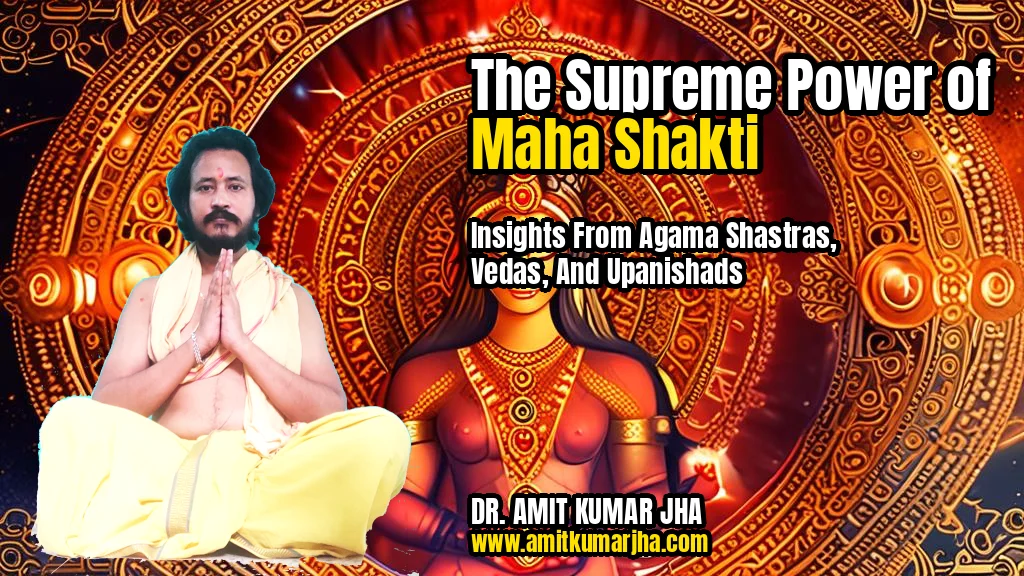

In the vast expanse of Sanatana Dharma, the concept of Shakti (Cosmic Energy/Goddess) represents the absolute primordial source of the universe. Among the most authentic and authoritative texts detailing the philosophy of Shakti are the Agama Shastras, alongside the Vedas, Upanishads, and Puranas. These texts establish that before the creation of the cosmos, the Goddess existed alone as the ultimate reality. As stated in the scriptures, “Devi hyekagre asīt” (The Goddess alone existed in the beginning) — when nothing else whatsoever existed, and she beheld only her own reflection.
Understanding Shakti requires looking past superficial misconceptions and diving into the subtle, non-dual Shakta philosophy. Whether viewed through the lens of the Agama Shastras, the Rigveda, or the profound poetic reverence of Shankaracharya in Saundarya Lahari, the Supreme Mother is the ultimate architect, sustainer, and dissolver of the universe. For broader historical context on scriptural traditions, refer to Agama on Wikipedia and Shaktism on Wikipedia.
1. Creation and the Primordial Reflection according to Agama Shastras
The Agama Shastras describe the unfolding of creation from the singular state of the Goddess. Prior to manifestation, when absolute stillness prevailed, the Goddess beheld her own reflection (Swabimba):
एतस्मिन्नेव काले तु, स्वबिम्बं पश्यति शिवा
English Transliteration:
Etasminneva kāle tu, svabimbaṁ paśyati śivā
Detailed Meaning:
"At this very time, the auspicious Goddess beheld her own reflection."
From this self-reflection, Maya (illusion) arose, which manifested as the mental Shiva:
तद्बिम्बं तु भवेन्माया-तत्र मानसिक शिवः
English Transliteration:
Tadbimbaṁ tu bhavenmāyā-tatra mānasika śivaḥ
Detailed Meaning:
"That reflection became Maya, and therein arose the mental Shiva."
Because the Goddess brought forth Adinatha (Shiva) from her own mind and accepted him as her consort solely for the purpose of world-creation, the Agama Shastras regard the Goddess (Shakti) as the mother even of Shiva. As the scripture notes:
तं विलोक्य महेशानि सृष्ट्युत्पादन कारणात्
आदिनाथं मानसिकं-स्वभर्तां तु प्रकल्पयेत्
English Transliteration:
Taṁ vilokya maheśāni sṛṣṭyutpāda kāraṇāt
ādināthaṁ mānasikaṁ-svabhartāṁ tu prakalpayet
Detailed Meaning:
"Beholding him, O Maheshaani, for the sake of producing creation, she appointed the mental Adinatha as her husband."
Although the Goddess manifested Adinatha from her mind to facilitate creation, she never became subservient to him; rather, Shiva remains dependent on her. The Sri Lalita Sahasranama honors the Goddess with the epithet Swadhinavallabha, signifying that Shiva remains under her absolute command, while she remains entirely independent.
2. Revelations from the Devi Bhagavata and Vahvricha Upanishad
In the seventh skandha of the Devi Bhagavata Purana, Bhagavati recounts her manifestation to her father, Himavan, the lord of mountains:
अहमेवाह पूर्वं च, नान्यत् किंचिन्नगाधिप
तदात्मरूपं चित्संवित् परब्रह्मैक नामकम्
स्वशक्तैश्च समायोगा-अहं बीजात्मतां गता
स्वाधारावरणा तस्या-दोषत्वं च समागतम्
English Transliteration:
Ahamevāha pūrvaṁ ca, nānyat kiñcinnagādhipa
tadātmarūpaṁ citsaṁvit parabrahmaika nāmakam
svaśaktyaiśca samāyogā-ahaṁ bījātmatāṁ gatā
svādhārāvaraṇā tasyā-doṣatvaṁ ca samāgatam
Detailed Meaning:
"O Lord of mountains, prior to creation, there was nothing else besides me. At that time, I alone was the Supreme Brahman, known as pure consciousness and existence. Through the union with my own inherent power, I became the seed-state, and adopting my own support and veil, the state of manifestation emerged."
Similarly, the Vahvricha Upanishad proclaims that the Goddess alone existed before creation. Parashakti is all-pervading, possessing the nature of Sat, Chit, and Ananda (Existence, Consciousness, and Bliss). The Upanishad states:
सैव जगदण्डमसृजत्। ब्रह्मा अजीजनत्। विष्णुरजीजनत्। रूद्रोअजीजनत्। सर्वशक्ति अजीजनत्। सैषाशाम्भवीविद्या। सैवात्मा। सच्चिदानन्दलहरी। प्रज्ञानं ब्रहमेति वा अहं ब्रह्मास्मीति वा भाष्यते।
English Transliteration:
Saiva jagadaṇḍamasṛjat | Brahmā ajījanat | Viṣṇurajījanat | Rudro'jījanat | Sarvaśakti ajījanat | Saiṣāśāmbhavīvidyā | Saivātmā | Saccidānandalaharī | Prajñānaṁ brahmeti vā ahaṁ brahmāsmīti vā bhāṣyate ||
Detailed Meaning:
"She alone created the cosmic egg. She produced Brahma, Vishnu, and Rudra. She produced all energies. She is Shambhavi Vidya. She is the Atman (Soul). She is the wave of Sat-Chit-Ananda. She is expressed as 'Prajnana Brahma' (Consciousness is Brahman) or 'Aham Brahmasmi' (I am Brahman)."
This self-luminous Shakti is worshiped in diverse forms, including the Dasa Mahavidyas (Kali, Tara, Tripura Sundari, Bhuvaneshwari, Tripura Bhairavi, Dhumavati, Chhinnamasta, Bagalamukhi, Matangi, and Kamala), as well as Pratyangira, Durga, Chandika, Gayatri, Savitri, and Saraswati.
3. Form and Unity of Shakti Across Vedic and Agamic Traditions
In various scriptures, the term 'Shakti' denotes the Supreme Para Brahman characterized by existence, consciousness, and bliss. The Vedas and Puranas refer to her as Mahadevi, Bhagavati, Ishwari, and Mula Prakriti. The Shrutis declare:
परास्यशक्तिर्विविधैव श्रूयते-स्वाभाविकी ज्ञान बल क्रिया च
English Transliteration:
Parāsyaśaktirvividhaiva śrūyate-svābhāvikī jñāna bala kriyā ca
Detailed Meaning:
"The supreme power of the Lord is heard of in manifold ways—naturally inherent as knowledge, strength, and action."
Shakta philosophy bridges all apparent sectarian divisions. The Ganapatis worship Ganapati, the Shaivas worship Shiva, the Vaishnavas worship Vishnu, and the Sauras worship Surya—yet all these deities are manifestations of the Trialokya-Sundari Maha Shakti. While Vedantins describe the ultimate reality in neuter terms and Vedic mantras often employ masculine terms, Shaktas worship this supreme Sat-Chit-Ananda as the Divine Feminine.
Agama Shastras detail both the unmanifest (Nirguna) and manifest (Saguna) forms of the Goddess. For example, the fierce form of Adya Kali—depicted with dark complexion, standing upon Mahakal in Shavasana, adorned with a garland of skulls, and holding a sword—instills profound detachment (Vairagya) and non-dual awareness in the seeker:
शव-रूप महाकाल हृदयाम्भोज वासिनी
सप्त प्रेतैक पर्यंक-शवहृद् राजते शिवा
English Transliteration:
Śava-rūpa mahākāla hṛdayāmbhoja vāsinī
sapta pretaika paryaṅka-śavahṛd rājate śivā
Detailed Meaning:
"Residing in the lotus of the heart of Mahakala who lies like a corpse, and seated upon a couch formed of seven ghosts over the heart of the corpse, shines the auspicious Goddess."
Furthermore, Agama texts establish the identity between the Goddess and Vishnu’s avatars. For instance, the masculine form of Adya Kali is Lord Krishna, as expressed in the sacred esoteric verse:
कदाचिदाद्या ललिता- पुंरूपा कृष्णविग्रहा ।
कदाचिदाद्या श्री तारा-पुंरूपा राम विग्रहा।
English Transliteration:
Kadācidādyā lalitā- puṁrūpā kṛṣṇavigrahā |
Kadācidādyā śrī tārā-puṁrūpā rāma vigrahā ||
Detailed Meaning:
"Sometimes Adya Lalita assumes the masculine form of Lord Krishna; sometimes Adya Tara assumes the masculine form of Lord Rama."
Scriptures systematically map the Ten Mahavidyas to the Ten Avatars of Vishnu (e.g., Kali as Krishna, Tara as Rama, Bhuvaneshwari as Varaha, Dhumavati as Vamana, Bagalamukhi as Kurma, etc.).
4. Scriptural Corroboration from Vedas and Upanishads
The Rigveda (Mandala 10, Sukta 125) features the famous Devi Sukta, where the Goddess proclaims her absolute supremacy across the cosmos:
अहं रूद्रेभि वसुभिश्चरामि...
अहं मित्रावरूणा-अहं इन्द्राग्नी...
अहं विष्णुमुरूक्रम ब्रह्माणमुत प्रजापतिं दधामि
English Transliteration:
Ahaṁ rūdrebhi vasubhiścarāmi...
ahaṁ mitrāvarūṇā-ahaṁ indrāgnī...
ahaṁ viṣṇumurūkrama brahmāṇamuta prajāpatiṁ dadhāmi
Detailed Meaning:
"I move about as the Rudras and the Vasus... I sustain Mitra and Varuna, Indra and Agni, and both Ashvins. I alone uphold Vishnu of vast strides, Brahma, and Prajapati."
The Upanishads consistently echo this truth:
- Shvetasvatara Upanishad: Elaborates on the manifold knowledge, will, and action of Parashakti.
- Kena Upanishad: Describes the Goddess as beyond speech, touch, and form: “Ashabdam asparsham arupam avyayam” (Soundless, touchless, formless, immutable).
- Mandukya Upanishad: Notes that Chitsgakti transcends speech, mind, and the senses: “Yato vacho nivartante-aprapyamanasa saha” (From whence speech turns back, unable to reach it along with the mind).
- Devi Atharvashirsha: States that even Brahma and the other deities do not know her true nature, hence she is called Ajneya (unknowable), Eka (one), Aja (unborn), and Vishvarupa (manifest in all forms).
5. The Inseparability of Shiva and Shakti
A core axiom of Agama Shastras is that without Shakti, even Shiva is like a corpse (Shava). The dynamic pulse (Spandana) of energy is life itself. Parameshwara and Parameshwari are inseparable, just as fire and its burning power are inseparable.
Lord Shiva Himself declares to Goddess Parvati in the Agamas:
शक्तिं बिना महेशानि! सदाहं शव रूपकः
शक्तियुक्तो महादेवि-शिवोहं सर्वकामदः
ईश्वरोहं महादेवि-केवलं शक्तियोगतः
English Transliteration:
Śaktiṁ vinā maheśāni! sadāhaṁ śava rūpakaḥ
śaktiyukto mahādevi-śivohhaṁ sarvakāmadaḥ
īśvarohaṁ mahādevi-kevalaṁ śaktiyogataḥ
Detailed Meaning:
"O Maheshani! Without you, I am ever in the form of a corpse. United with Shakti, O Mahadevi, I am Shiva, the fulfiller of all desires. I am Ishvara only through my union with Shakti, O Mahadevi."
The scriptures emphasize that without Shakti, Shiva has neither name nor abode, and the Supreme Lord remains incapable of any action whatsoever: “Paro hi shaktirahitah shaktah kartuṁ na kiñchana” (He who is devoid of Supreme Shakti is powerless to do anything).
6. Adoration in the Puranas and Adi Shankaracharya's Saundarya Lahari
The Markandeya Purana (Durga Saptashati) extols the Goddess as the foundational substrate of the universe:
- “Ādhārabhūtā jagatastvamekā” (You alone are the sole support of the universe)
- “Tvayaitat dhāryate viśvam” (By you is this universe held)
- “Sṛṣṭi sthiti vināśānāṁ-śaktibhūte sanātani” (O Eternal One, you are the power behind creation, maintenance, and destruction)
Similarly, the Brahmavaivarta Purana records Lord Krishna praising the primordial Mother as Mula Prakriti, Ishwari, and the source of all triads and seed elements.
No exposition on Shakti is complete without referencing Adi Shankaracharya’s Saundarya Lahari, the pinnacle of Shakta devotional poetry. In the very opening verse, Acharya Shankara establishes the absolute primacy of Shakti:
शिवः शक्त्यायुक्तो यदि भवति शक्तः प्रभवितुं
English Transliteration:
Śivaḥ śaktyāyukto yadi bhavati śaktaḥ prabhavituṁ
Detailed Meaning:
"If Shiva is united with Shakti, only then is he empowered to create; if not, he is incapable even of movement."
Shankara further marvels that while Brahma has four faces, Shiva five, Kartikeya six, and Adisesha a thousand, none can fully describe the infinite glory of the Mother. He famously notes that even Shiva attained the supreme title of Lord of the Universe (Jagadisha) solely as the fruit of marrying Devi Bhavani:
कपाली भूतेशो भजति जगदीशैक पदवीं
भवानी त्वत्पाणिग्रहण परिपाटी फलमिदम्
English Transliteration:
Kapālī bhūteśo bhajati jagadīśaika padavīṁ
bhavānī tvatpāṇigrahaṇa paripāṭī phalamidam
Detailed Meaning:
"That Bhutesha (Shiva), who carries a skull and roams cremation grounds, attains the unique title of Lord of the Universe—O Bhavani, this is simply the fruit of the sacred ritual of taking your hand in marriage!"
Shankara concludes that the closing and opening of the Goddess's eyelids govern the dissolution and creation of the entire cosmos: “Nimeṣonmeṣābhyāṁ pralayamudayaṁ yāti jagatī”.
Conclusion
The Agama Shastras, Vedas, Upanishads, and Puranas converge on a singular, magnificent truth: Maha Shakti is the absolute, independent, self-luminous reality underpinning all existence. From the first reflection that stirred the cosmic void to the rhythmic pulse of Kundalini awakening within the human frame, Shakti is both the path and the goal. Recognizing her supremacy bridges all philosophical paths, uniting knowledge, devotion, and action in the realization of the non-dual Divine Mother.